
What is the MOTS-c peptide?
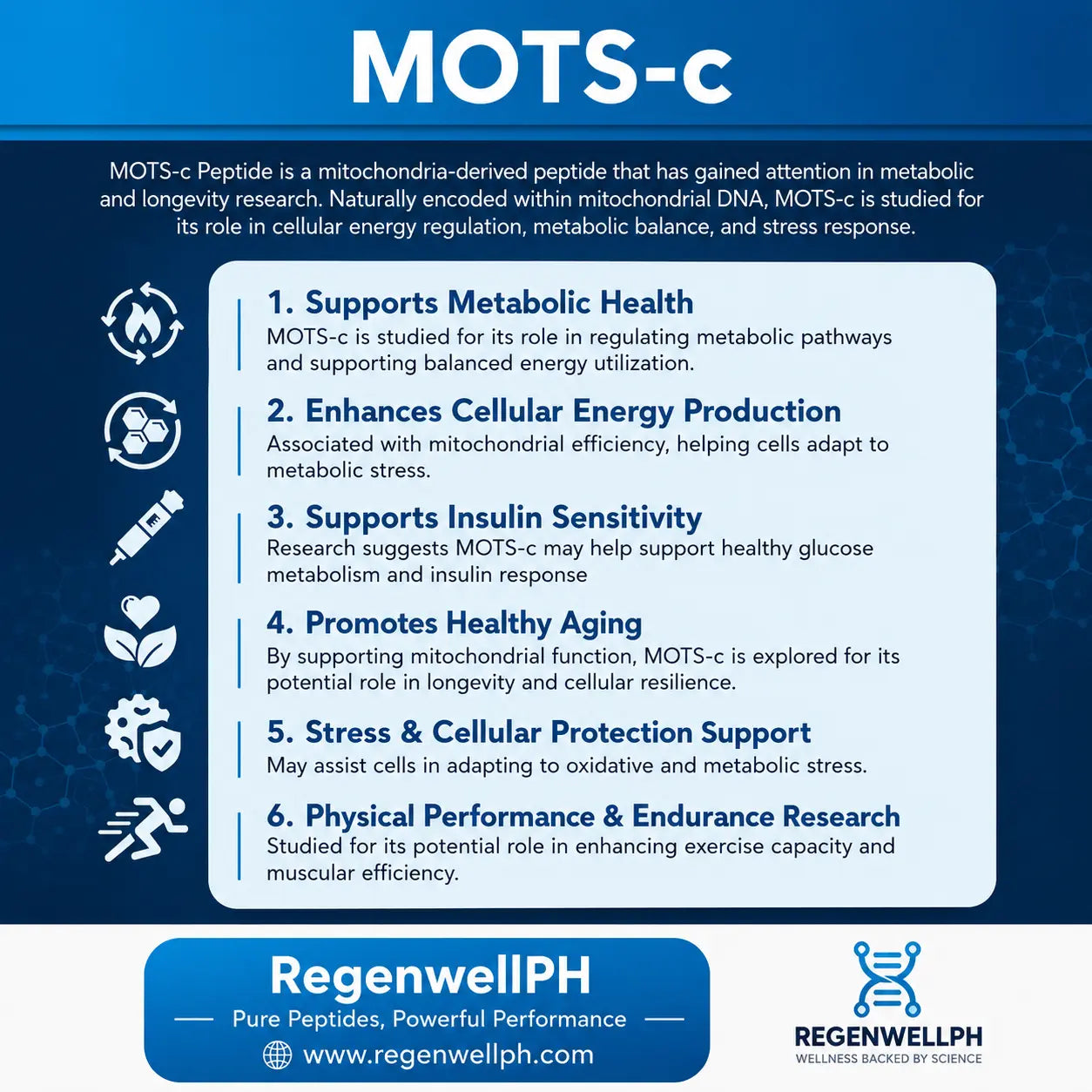
Unlike muscle-building peptides that work through growth hormone pathways — MOTS-c operates through metabolic and stress response mechanisms. Its primary target appears to be skeletal muscle (though effects extend to the liver), fat tissue, and brain. This guide examines everything we know about MOTS-c benefits, from the molecular mechanisms to practical applications.
In animal studies, MOTS-c prevented age-related insulin resistance and obesity even in mice fed a high-fat diet.

Certified GMP onsite audits and a new Certified Facility program that encompasses banned substances, label claims and contaminants, and GMP compliance. Finished product certifications include banned substances (label claims and contaminants), and GMP compliance.General quality control testing is also available.
As understanding of MOTS-c mechanisms improves — research may identify optimal combinations with other compounds. MOTS-c can theoretically be combined with other compounds, though research on specific combinations is lacking. For those already taking metformin — adding MOTS-c would introduce unknown interactions and duplicated mechanisms. A common middle-ground protocol involves 5 to 10mg administered subcutaneously once every five days for 20 days. But the mechanisms suggest potential for enhanced results when MOTS-c supplementation accompanies a training program.
Aspirin at higher doses has AMPK-activating properties. Combining metformin with MOTS-c creates additive or synergistic AMPK activation that could produce excessive effects. Metformin (the most commonly prescribed diabetes drug), works primarily through AMPK activation.
Start with lower doses than commonly recommended, typically 2.5-3mg rather than 5mg per injection. Here are specific modifications for common problems. GLP-1 agonists commonly cause nausea (vomiting), diarrhea, and constipation, particularly when starting or increasing doses. Taking doses on workout days (particularly before exercise), can enhance the synergy between exogenous MOTS-c and exercise-induced AMPK activation. Rather than jumping to common protocol doses, start at 50-75% of typical doses and increase gradually over two to three weeks.
Laboratory and cell research
Track your training output (recovery and waist measurement alongside the labs), because subjective energy alone is easy to fool. Some people report transient fatigue or mild nausea at higher doses of 15 to 20 mg — which is one more reason I stay at 1 mg. Persistent injection site reactions were common with CB4211, and efficacy data from those trials still hasn’t been published. Mice have faster metabolisms, different body surface area to mass ratios and different receptor densities, so the human doses above are conservative extrapolations from that data.
What MOTS-c Is Studied For
Some protocols simply skip dosing on rest days, especially when the schedule is built around workouts. Consistency of time-of-day and routine matters more than chasing a perfect window. For multi-day-per-week schedules, spacing doses evenly (for example, Monday/Wednesday/Friday, or five weekday mornings) helps maintain steady exposure. Because AMPK signaling is heightened in the fasted state, MOTS-c is commonly taken before eating in the morning. When traveling (transport in an insulated cooler with a cold pack), keeping the vial cold but not frozen. Once mixed, plan to use within about 28 days, and discard early if the solution turns cloudy, discolored, or shows particulate.
The peptide improves glucose uptake in skeletal muscle (reduces insulin resistance), and supports healthy lipid levels. Here is what a realistic timeline looks like for a healthy male using standard dosing alongside consistent training. The mitochondrial specificity of MOTS-c makes it mechanistically complementary to compounds acting through other pathways.

Aging, Mitochondrial Function, and Longevity Signals
Regardless of the season, periods of intensified training or dietary intervention should be aligned with usage. A different approach involves maintaining consistent administration at lower doses instead of alternating on and off cycles. The typical cycling pattern involves alternating between active use and complete breaks. Peptide administration occurs on training days, whereas rest days may either follow the morning protocol or forgo dosing based on the frequency schedule. To enhance training adaptations, the timing of MOTS-c is utilized pre-exercise for performance-oriented applications due to its exercise-mimicking properties. The approach of administering MOTS-c in the morning while fasting is the most prevalent timing method.
It is legally sold in most jurisdictions as a research chemical for laboratory use only, not for human consumption, and it cannot lawfully be marketed with therapeutic claims. No standardized human dose exists, and these figures describe what has been reported rather than what anyone should do. Cautious framing is appropriate; confident safety claims are not supported. Reported side effects are mild and mostly local, with injection-site irritation being the common one and dose-related fatigue or headache appearing less often. Our MOTS-c dosage chart sets label and trial doses beside what Reddit users report taking. At 5 mg twice weekly — a 10 mg vial is exactly one week of dosing and is finished comfortably inside the roughly 14-day reconstituted window.
The effects of repeated heat exposure on MOTS-c and FGF21 levels were investigated during leg immobilization to determine whether heat therapy could replicate the exercise benefits on muscle. Communication between muscle and fat (initiated by exercise), supports metabolic health, and substances like MOTS-c might replicate some of these advantages. This study investigated MOTS-c levels in individuals with and without obesity, exploring their associations with insulin resistance, vascular function, and inflammation. Adults with obesity exhibited elevated circulating levels of MOTS-c (which were associated with metabolic and inflammatory markers), showing no change after weight loss.
SS-31 might be considered more targeted toward mitochondrial protection specifically. Both MOTS-c and SS-31 target mitochondrial function, but through different mechanisms. Positioning MOTS-c among related compounds helps clarify when it might be most relevant. The common peptide mistakes guide covers errors that increase risk with any compound. It falls under Section 4.4 (Metabolic Modulators, specifically AMPK activators) on the prohibited list. These typically resolve within days and can be minimized with proper technique and site rotation.
This indicates a dose-dependent compromise that must be considered when creating a protocol tailored to specific objectives. However (if high doses of MOTS-c are used while simultaneously striving for maximum muscle growth), you could be counterproductive. At increased doses — significant AMPK activation may actually hinder an anabolic environment. When reconstituting MOTS-c, the precise steps for mixing and unit calculations apply whether you have a 10 mg or 40 mg vial. It deteriorates more rapidly than several widely used peptides, such as BPC-157 or CJC-1295.

The injection method rather than the peptide itself accounts for the most frequently reported side effects. In a 2016 investigation, scientists analyzed MOTS-C’s protective qualities against osteoporosis following ovariectomy in mice. Aging often leads to deteriorating bone health, with many elderly individuals experiencing bone-related ailments like osteoporosis or osteoarthritis. Studies indicate that MOTS-C can enhance insulin distribution and sensitivity — particularly in skeletal muscle.
Recent Blogs
-
SpinPanda Casino: Mobiele Ervaring
Nov 24, 2026 -
Spinning for Luck at the CashLounge Casino
Nov 24, 2026 -
Lucky Fruits Casino: A Slot Machine Experience
Nov 24, 2026